Pronation-External Rotation Ankle Injuries
How a pronation-external rotation ankle injury fails from the medial side out, why the fibula breaks high in a Weber C, and when to image the whole leg.
Last reviewed 2026-07
You get an ankle series after a twisting fall, and there’s a fibula fracture. The temptation is to describe the fracture and move on. The question that actually changes management is whether the ankle is stable, and the fibula fracture on its own doesn’t answer it.
How the Injury Happens#
Picture the foot planted and pronated while the body keeps turning, so the talus rotates outward and drives against the fibula. The restraints fail in order, from the medial side outward. The medial structures go first: either the deltoid ligament tears or the medial malleolus avulses. The anterior part of the syndesmosis tears next. Then the fibula itself breaks, above the syndesmosis, and finally the posterior structures give.
The useful part of that sequence is where the fibula sits in it. The fibula is one of the last things to fail, and it fails above the syndesmosis. By the time you can see a fibula fracture, the medial side and the syndesmosis below the fracture have already come apart. So the level of the fibula fracture is a record of how far the injury traveled up the leg before the bone finally broke.
Weber Level Is a Stability Question#
The Weber classification sorts distal fibula fractures by where they sit relative to the syndesmosis. The syndesmosis is what binds the distal fibula into the tibia and keeps the mortise tight around the talus, so its condition is what stability comes down to.
| Weber | Fibula fracture | Syndesmosis | Stability |
|---|---|---|---|
| A | Below the syndesmosis | Intact | Usually stable |
| B | At the syndesmosis | Variable | Depends on the medial side |
| C | Above the syndesmosis | Torn below the fracture | Unstable |
A pronation-external rotation injury lands in the Weber C row. The fracture is above the syndesmosis, which means everything holding the fibula to the tibia below the fracture has already torn. Treat the letter as shorthand for one question: how much of the syndesmosis is still doing its job.
What to Check on the Films#

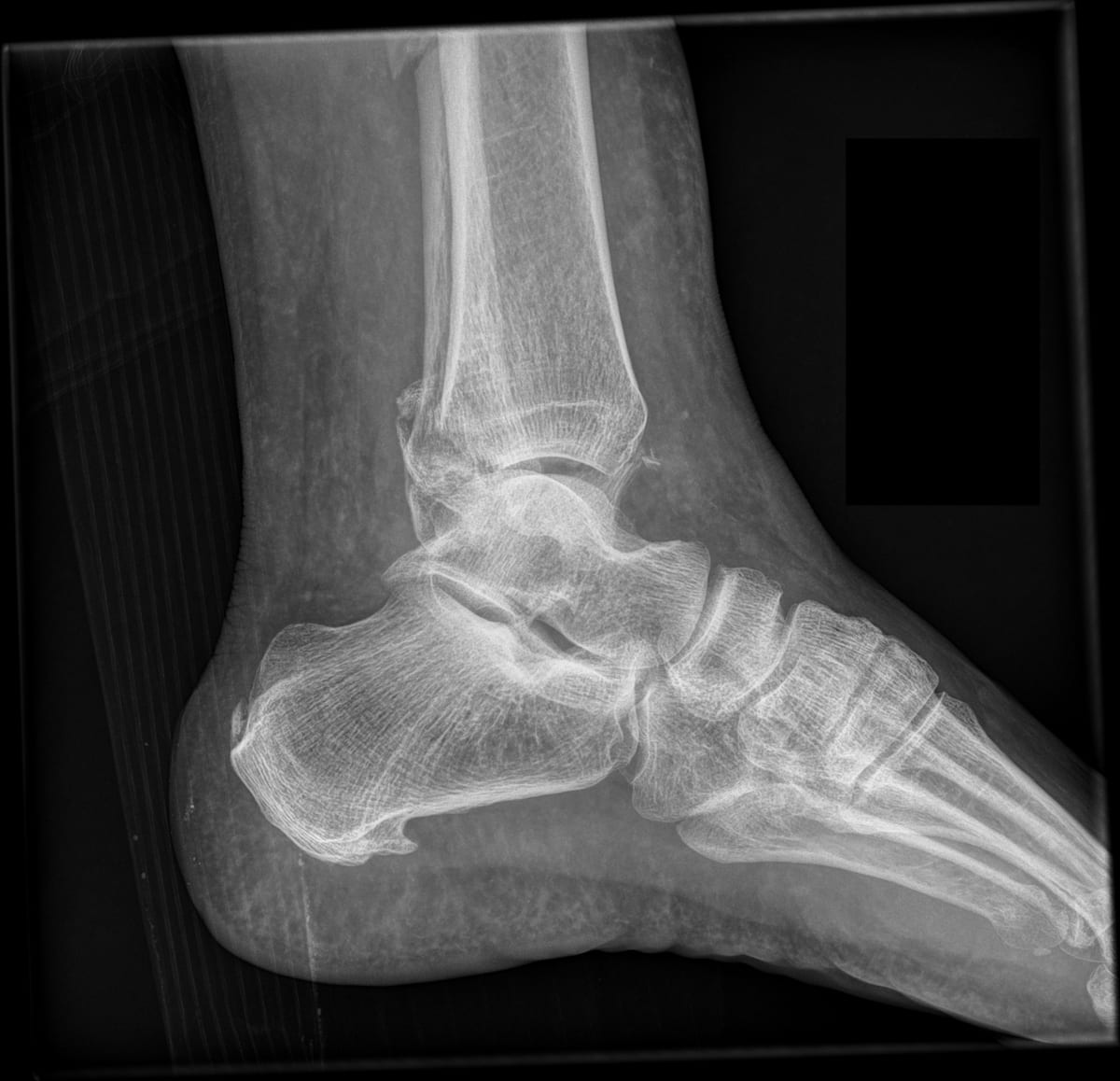
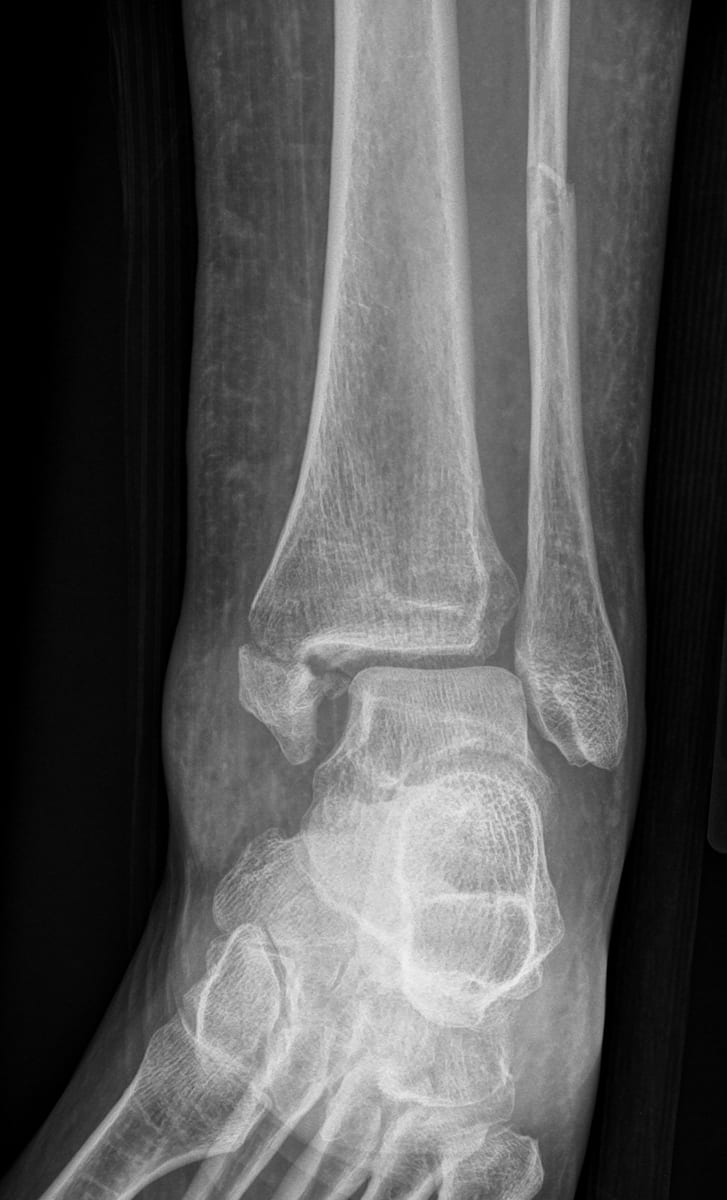
The case above is a high-grade pronation-external rotation injury. Work the same four checks across both views:
- The medial side. Look for a transverse medial malleolus fracture, or a medial clear space wider than the space between the plafond and the talar dome. A wide medial clear space with an intact medial malleolus means the deltoid tore.
- The syndesmosis. Check the tibiofibular clear space and the tibiofibular overlap.
- The fibula. Find the fracture and note its level. Then ask whether it’s even on the film.
- The talus. Decide whether it sits centered under the tibia or has shifted laterally in the mortise.
The One That Gets Missed#
The trap in this pattern is the fibula fracture that isn’t on your film. If the medial side is injured, a medial malleolus fracture or a widened medial clear space, but you can’t find a fibula fracture anywhere on the ankle series, the fibula still broke. It just broke proximally, above the top of the film. That’s the Maisonneuve variant, and it’s the same pronation-external rotation sequence carried all the way up the leg.
Medial widening with no visible fibula fracture
A widened medial clear space with no fibular fracture on the ankle views is a proximal fibula fracture until you image the whole leg. Get full-length tib-fib or leg views before you sign it off.
The Bottom Line#
Read the fibula fracture, but don’t stop there. Check the medial side and the syndesmosis, decide whether the mortise is stable, and if the medial side is injured with no fibula fracture on the ankle film, image the whole leg. A fracture above the syndesmosis usually goes to the OR for fixation rather than into a cast, so the word the surgeon needs from your report is unstable, not just the Weber letter.